
Find Guilford County Voter Records
The NCSBE Voter Search is the official individual lookup for Guilford County. Enter both first and last name, then add a middle initial or birth year when common names produce several matches. Selecting Guilford in the county list prevents unrelated profiles elsewhere in North Carolina from crowding the results. The status controls can show registered people as well as removed or denied records.
| Lookup control | Input | Required | How to use it |
|---|---|---|---|
| First Name | Text | Yes | Use the registered given name |
| Middle Initial | Text | No | Narrows people with the same full name |
| Last Name | Text | Yes | Spelling must match the voter roll |
| Year of Birth | Dropdown | No | Narrows results without publishing a full birth date |
| County | Dropdown | No | Choose GUILFORD for a local search |
| Voter Status | Checkboxes | One | Registered, Removed, or Denied |
JavaScript must be enabled for submission. If a record cannot be found, try the name used at registration and a broader status selection before contacting the county. The tool is a profile lookup, not a screen for browsing every ballot choice or private application field.
The official North Carolina voter lookup shows the controls used for a Guilford County search.
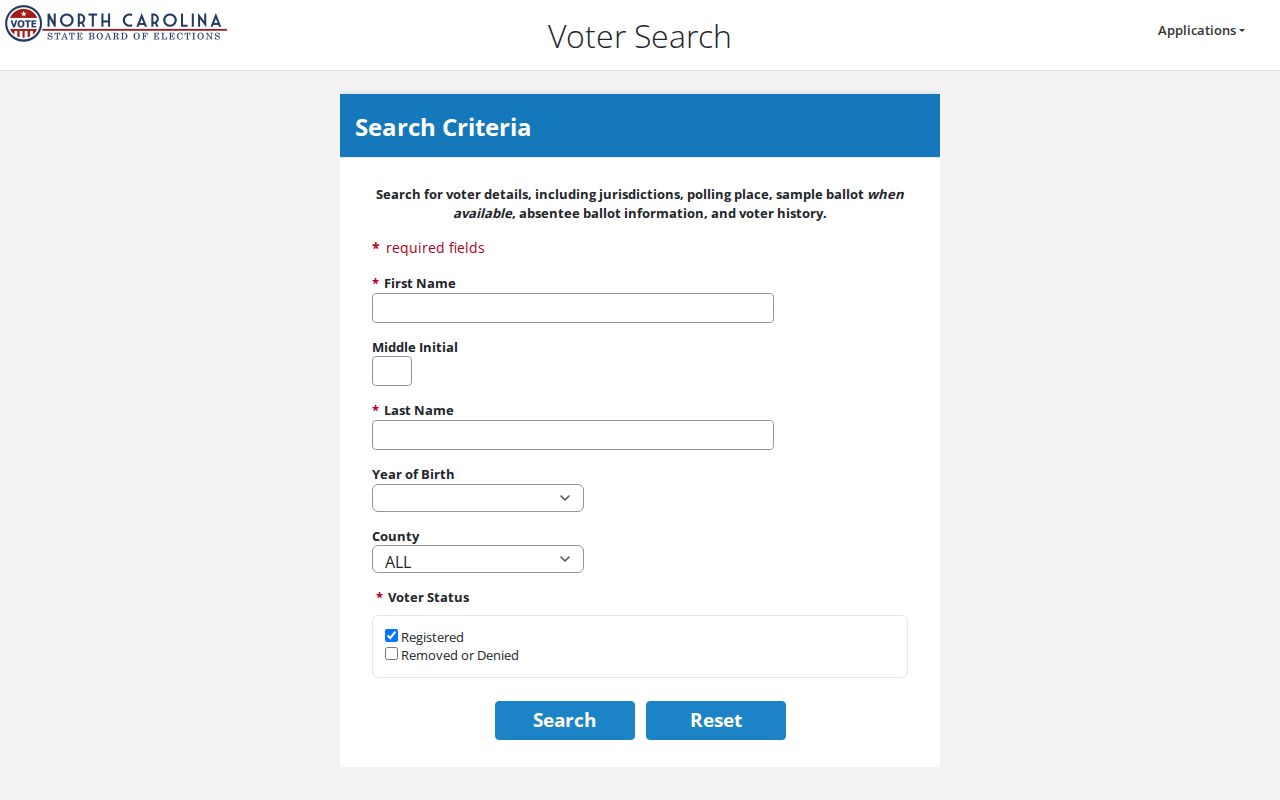
Its county and status filters make a same-name result much easier to test before opening a profile.
Guilford County Voter Profile Fields
The state’s public voter profile guide divides a record into six useful parts. Voter details identify the registration. Jurisdictions show the precinct and elected districts tied to that address. The polling-place section gives the assigned site, while sample-ballot links appear for an active election. Absentee or early-voting information can appear when applicable. Voter history records participation.
| Identity and status | Name, county, status, county registration number, NCID, and party or unaffiliated status |
|---|---|
| Districts | Precinct, municipality when applicable, congressional, legislative, commission, school, and other districts |
| Voting site | Polling-place name, address, and voting-place information |
| Election material | Sample-ballot links and applicable absentee or early-voting status |
| History | Election, county, precinct, and voting method, never selections |
The NCSBE explanation of voter profiles shows how those parts fit together.

The six-part layout separates registration facts from election tools and helps prevent a participation entry from being mistaken for a vote choice.
Confidential Guilford County Voter Records
North Carolina draws a firm line between an open registration record and the sensitive data used to create it. G.S. 163-82.10 makes registration records public, but the computerized list is limited to political, election, scholarly, and journalistic purposes under the current statutory text. G.S. 163-82.10B protects date of birth except for narrow authorized uses. Social Security and driver-license numbers from the application also remain confidential.
Protected voter information. Full birth dates, Social Security and driver-license numbers, and qualifying protected addresses are not ordinary public voter registration fields under G.S. 163-82.10 and 163-82.10B.
A voter with a qualifying protective or no-contact order, or an active North Carolina Address Confidentiality Program card, may submit a signed safety statement under G.S. 163-82.10(e). Election officials then withhold the address while the name, precinct, and other registration facts remain public. An address found in an older source should not be republished when the current profile reflects this protection.
These election-specific rules are narrower than the general North Carolina public records framework. The county board and NCSBE remain the right custodians for questions about a withheld field. A request to another county department will not turn confidential application data into an open record.
Guilford County Voter History Limits
Voter history answers one narrow question: whether a person participated in a named election and by what method. It may show election, county, precinct, and voting method. It never reveals a candidate, contest selection, or ballot position. That distinction matters when comparing voter records with election results. A participation record cannot prove how anyone voted.
The state publishes weekly history downloads for the past ten years, while election snapshots and grouped totals reach farther back. County history files follow people currently registered in that county. For a past Guilford election, the more reliable method is to use statewide history and filter the voted-county field to GUILFORD.
The NCSBE voter-history download page provides the data notes and layouts used to interpret each field.
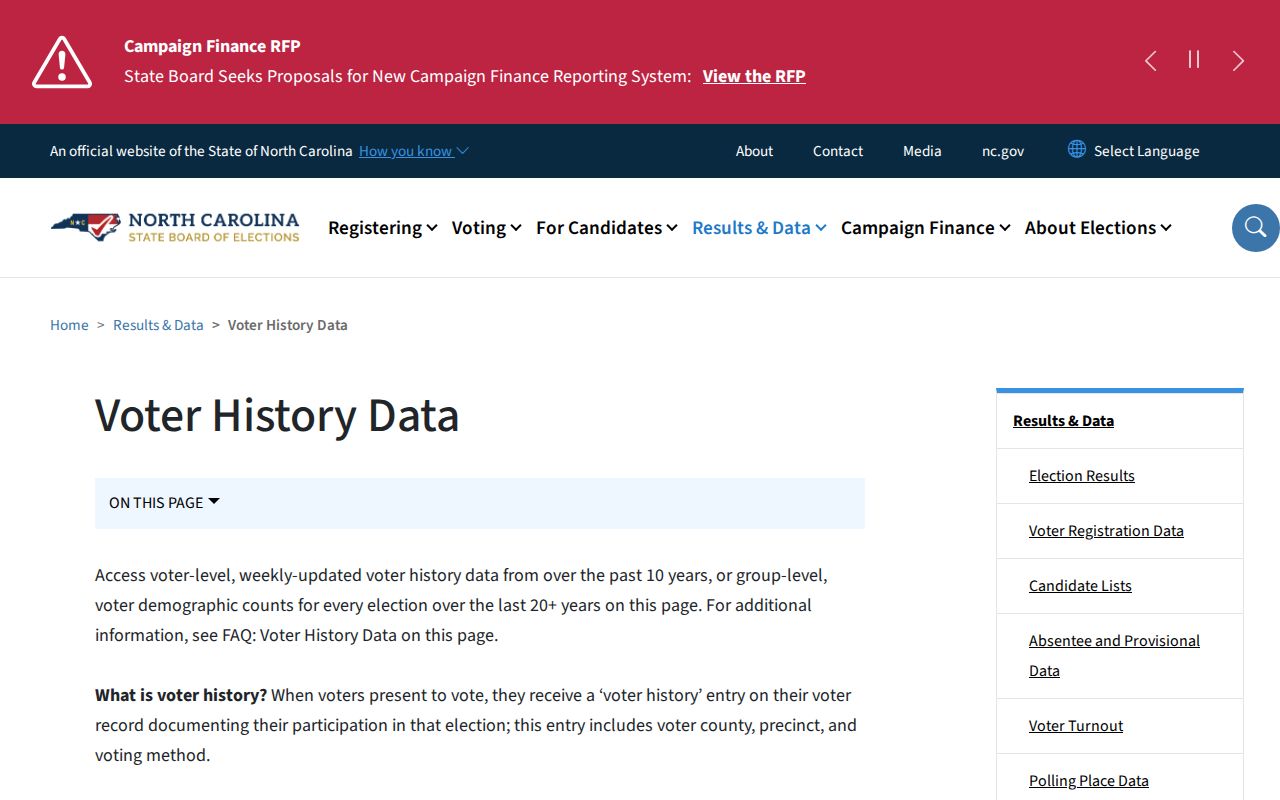
The layout is essential because registration numbers and NCID values join the history file to a registration record while names are omitted from the history extract.
Download Guilford County Voter Rolls
North Carolina supplies standard statewide and county files at no charge. There is no separate Guilford County purchase form or local fee for the ordinary extracts found in the research. The voter registration data page offers current compressed text files and their layouts. Registration data covers registered and formerly registered people plus attempted or incomplete registrations, subject to the published retention rules.
- Choose registration or voter-history data and decide whether the research calls for a Guilford County file or the statewide file.
- Download the dated compressed file and its matching layout. Keep both together so abbreviated columns are not guessed.
- Filter by county, status, precinct, district, or other public field. Apply the statutory purpose limits before using or sharing the data.
Registration extracts may include status and reason, demographics, party, address, precinct, legislative districts, judicial district, commission district, and local districts. They exclude date of birth, Social Security number, driver-license number, and voter history. History is a separate dataset joined by NCID or by county and registration number.
The official NCSBE voter-file page identifies the county downloads and file documentation.
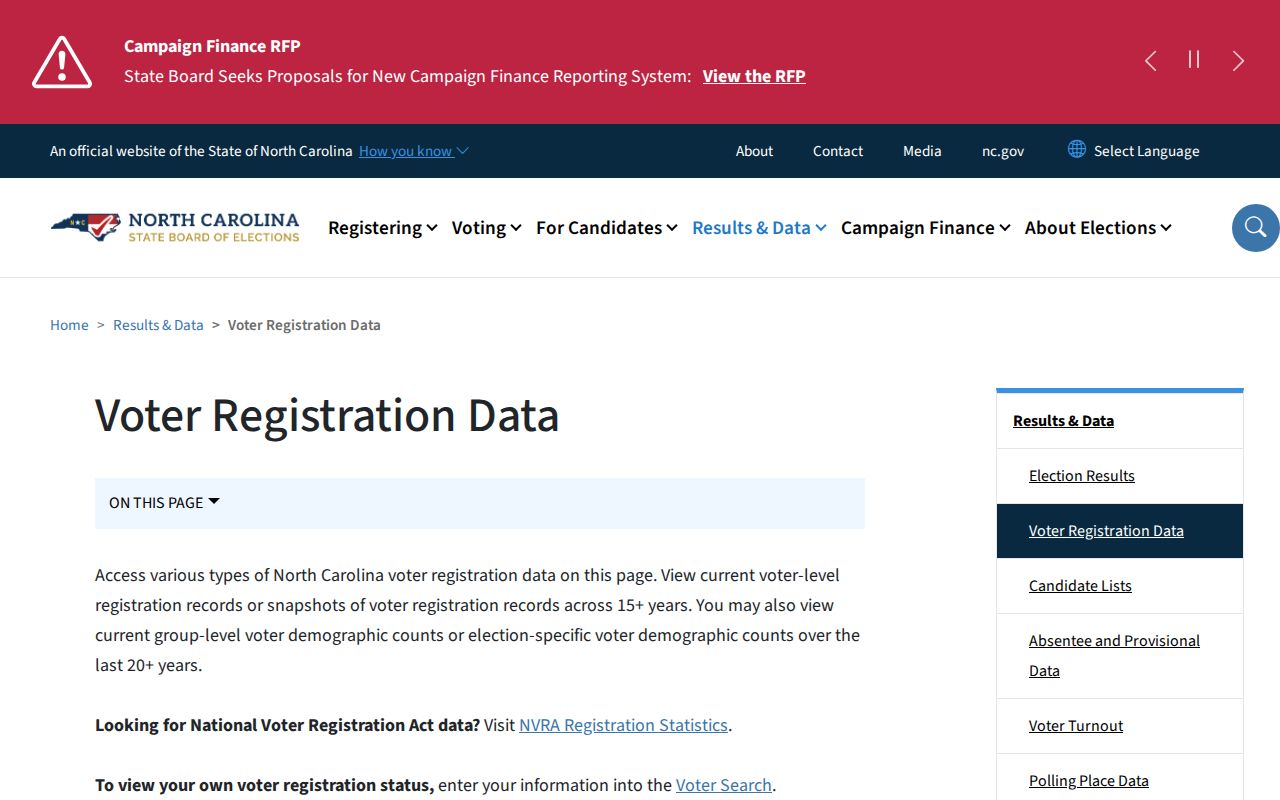
Reading the published layout before filtering preserves the distinction between current, former, denied, and incomplete records.
Use voter files lawfully. North Carolina limits computerized-list use, and public availability never permits stalking, harassment, threats, impersonation, or fraud.
Guilford County Voter Status Changes
An inactive label is not an instant cancellation. Address-confirmation procedures, notice, and federal National Voter Registration Act safeguards govern the process, including a two-federal-election waiting period in the applicable sequence. A returned mailing alone does not prove that a voter died or moved. Likewise, a removed record needs context from the status reason and the county election office.
Current registration files omit certain removed voters whose most recent last-voted date is more than ten years old. That rule can explain why an older person disappears from a live download even though historical election or registration material may survive elsewhere.
Search the individual profile with both Registered and Removed or Denied selected when a current-only query fails. Then compare the county registration number or NCID, not just the name. Common names, changed surnames, incomplete applications, and county moves can produce records that look alike but have different administrative histories.
Note: Treat inactive and removed as administrative statuses to research, not as proof about a person’s residence, life, or conduct.
Correct Guilford County Voter Records
The Guilford County Board of Elections is the local correction and request desk. A voter who sees a wrong name, address, status, precinct, or district should provide a full name, prior and current Guilford address, and the registration number or NCID when known. Date of birth may be given privately when staff need it to distinguish records.
Guilford operates election offices at 301 W. Market Street in Greensboro and 325 E. Russell Avenue in High Point. Both are open weekdays from 8:00 a.m. to 5:00 p.m. The shared phone is 336-641-3836, fax is 336-641-7676, and email is guilfordelections@guilfordcountync.gov. Those two counters reflect the county’s two-city service pattern.
Ask staff to explain the specific field rather than to certify a broad conclusion about the person. A precinct issue may stem from district geography, while a status issue may reflect a notice or pending update. Save the date of contact and the corrected profile so a later change can be compared against an identified source.
Greensboro Election Office
301 W. Market St.
Greensboro, NC
336-641-3836
High Point Election Office
325 E. Russell Ave.
High Point, NC
336-641-3836
Guilford County Registration Totals
County statistics are a snapshot, not a permanent population count. Guilford’s July 6, 2026 report listed 392,696 registered voters and supplied precinct tables by party, race, sex, and ethnicity. Those totals will change as registrations, removals, corrections, and district assignments are processed. Always record the report date with any figure.
The county’s voter registration statistics page preserves the date and local breakdown behind the total.
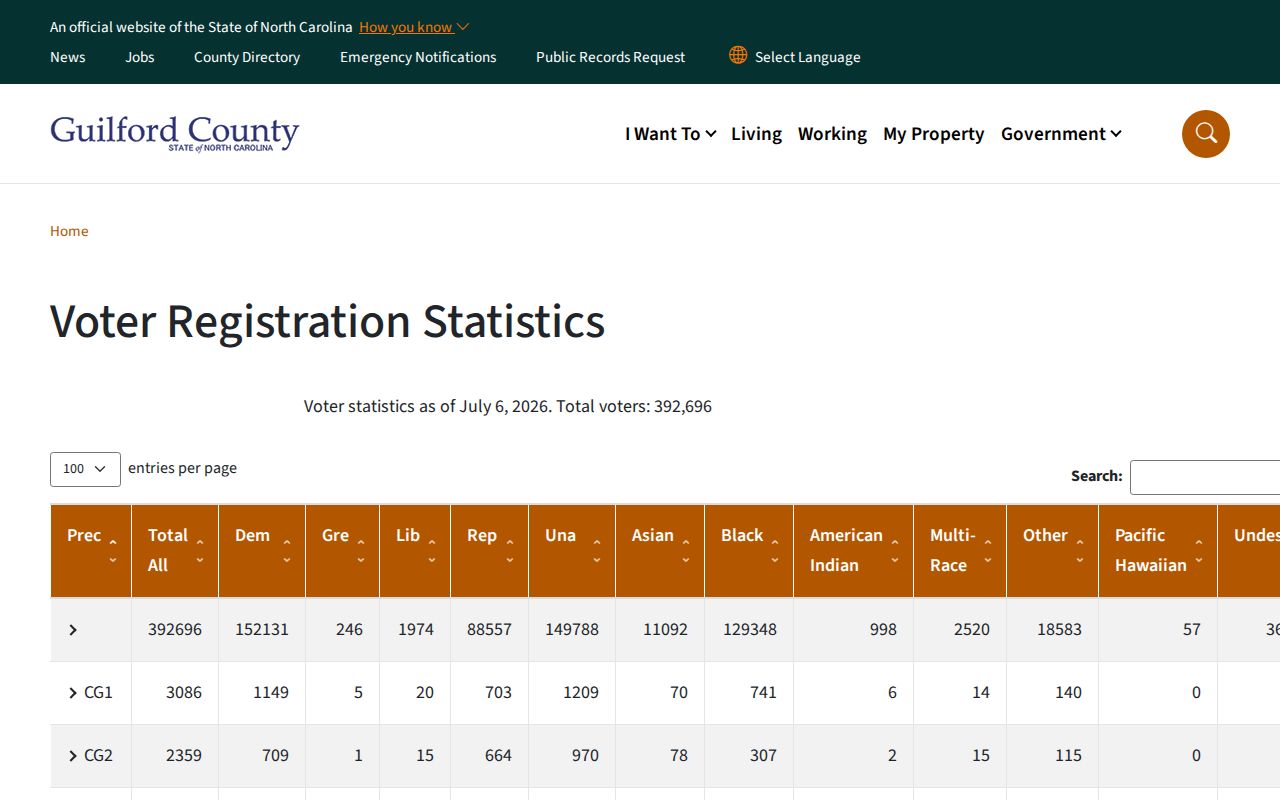
Precinct-level categories make the report useful for civic research, but they do not identify any person’s ballot selections.
Historic Guilford County Voter Registers
Older voter rolls may move beyond the live tool to county board minutes, library microfilm, and the State Archives county records guide. Poll books and registration books may be arranged by precinct instead of name. Exact Guilford year spans were not verified, so a useful request names the election, precinct, record type, and date rather than assuming a complete run.
The state retention schedule covers poll lists, registration rosters, and authorization-to-vote records. Routine nonfederal election material may be destroyed two months after certification and federal election material after 22 months, though counties must consult Archives before destroying old poll or voter registration books. That schedule explains why survival must be checked series by series.
Historical records may document participation or a registered address at one date. They still do not disclose ballot choices. Compare a poll-book entry with a city directory, newspaper, or census only after confirming the precinct and spelling used at that time.
Guilford County was created in 1771 from Rowan and Orange Counties, and Randolph County was formed from Guilford in 1779. For the earliest civic lists, those county changes can alter the correct archive or courthouse series. Modern search assumptions should not be projected onto books organized by an old precinct or township.