
Finding People Across Guilford County
Choose the first official index by what is known. A full or partial name works well in the county appraisal roll, Register of Deeds index, North Carolina Court Portal, voter lookup, and state business search. An old street address points first to the appraisal roll and GIS. A family date or relationship belongs in marriage indexes, estate files, obituaries, cemetery records, and library collections. Each source describes a role at a certain time. None should stand alone as proof of where someone lives now.
Guilford County has two strong urban trails. Greensboro records often lead through county-seat offices and the Greensboro library collections. High Point has its own courthouse services, deed counter, directories, newspapers, and industrial history sources. Small towns and unincorporated areas add a further wrinkle because a postal city is not always the government that kept a permit or local file.
- Search the appraisal roll by owner or address, then save the parcel number and both address fields.
- Follow the deed book and page into the Register of Deeds index to identify prior and later parties.
- Check the court index by name, county, case type, and date. Confirm the person’s role before drawing a link.
- Use voter, business, license, obituary, and directory sources to test the same identity in a second record trail.
- Ask the proper custodian for a file, copy, or older index when the web search ends.
Note: Record every spelling, middle initial, date, address, and party role before deciding that two Guilford County search results identify one person.
Guilford County People Records Counters
Several custodians support a Guilford County people search. The Register of Deeds preserves land instruments, assumed names, births, deaths, and marriages. The Clerk of Superior Court holds civil, criminal, estate, and special-proceeding files. Tax and Land Records connect an owner to a parcel, situs address, tax mailing address, and legal description. Full access rules and copy procedures belong with the county’s public records search, but these offices are the key starting points.
Register of Deeds, Greensboro
201 W. Market St.
Greensboro, NC 27401
336-641-7556
Register of Deeds, High Point
325 E. Russell Ave., Room 155
High Point, NC 27260
336-641-7556
Clerk of Superior Court
Greensboro and High Point counters
Guilford County, NC
336-412-7300
Tax and Land Records
Owner, address, and parcel records
Guilford County, NC
Free online lookup
Both Register of Deeds locations serve the same county system. Weekday office hours are 8:00 a.m. to 5:00 p.m.; the court counters have their own schedules. Contact the office before travel if a certified copy, archived book, or specific case file is required.
Guilford County Owner Search Shortcut
The Real Property Listing system is often the quickest name-to-address route. Enter at least three letters and use the county’s preferred format, “Last name, First name.” A comma after the surname limits the search to that surname. Address searches accept the first three street letters or first three digits, though a broad number may produce false matches. Parcel numbers use up to seven digits without leading zeros.
The official Guilford County owner search shows the portal used for owner, parcel, and address lookups.
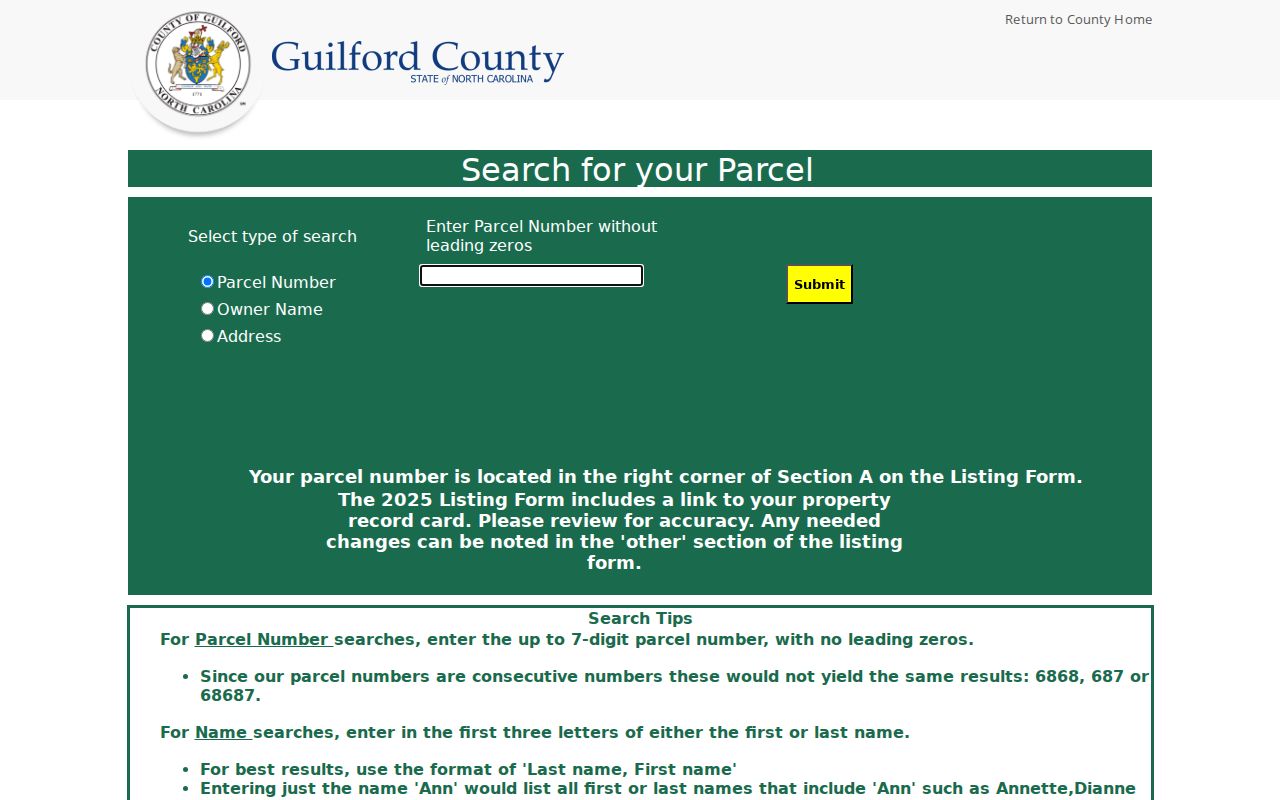
The owner result can expose both the situs, meaning the parcel’s physical location, and the mailing address used for tax notices. A different mailing address can be useful, but it might belong to a trust, office, post-office box, or tax service. Treat it as a lead, not a confirmed home.
Guilford County Deed Name Lookup
The Register of Deeds portal follows party names rather than street addresses. A grantor gives or transfers an interest; a grantee receives it. Search by last or company name, add a first name when needed, and select grantor, grantee, or both. Instrument categories include deeds, deeds of trust, foreclosures, powers of attorney, releases, plats, and assumed names. The portal displays FullText and SoundsLike options, but they are disabled, so spelling variants require separate searches.
| Search control | Useful choice | What it changes |
|---|---|---|
| Party Type | Grantor, Grantee, Both | Limits the person’s role |
| Entity Type | Person, Company, Both | Separates individuals from entities |
| Instrument Category | Deeds, liens, maps, releases, more | Narrows record type |
| Date pair | Start and end dates | Pre-1997 entries reduce dates to the year |
| Book and Page | Known citation | Retrieves a specific record path |
The Guilford County Register of Deeds name search provides this mix of name, party, category, date, and book controls.
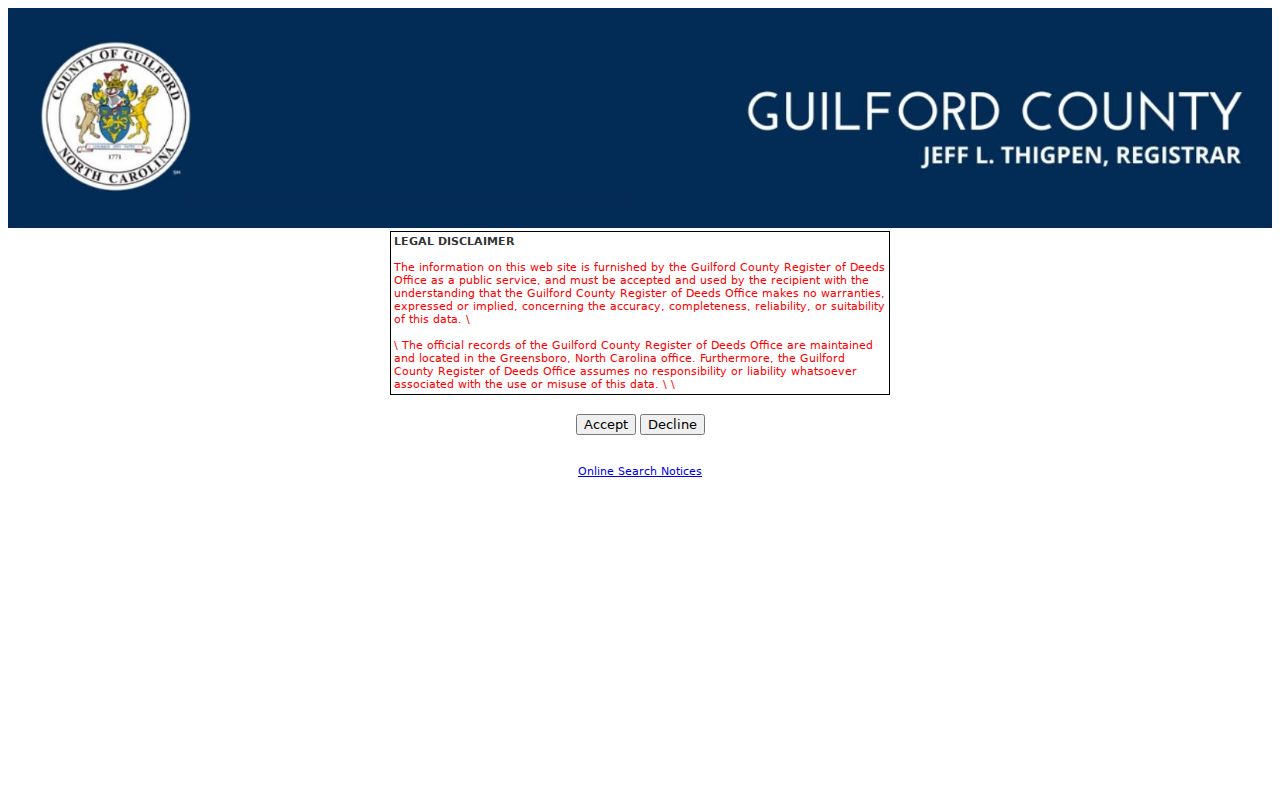
Search results identify indexed parties, role, instrument, recording date, and book/page or instrument reference. The image may add return addresses, legal descriptions, signatures, and parcel data. A recorded deed documents a transfer. It does not prove present occupancy.
Guilford County Court Name Records
North Carolina’s Court Portal lets a searcher use a name, case number, attorney, location, case type, and date filters. Select Guilford County to cut down statewide same-name matches. Then verify the party role, filing date, case class, and status. A docket is the court’s event list for a case. Depending on case type, the index may show parties, attorneys, hearings, charges, or dispositions.
The Guilford County court contact directory identifies the local divisions that hold the files behind those index entries.
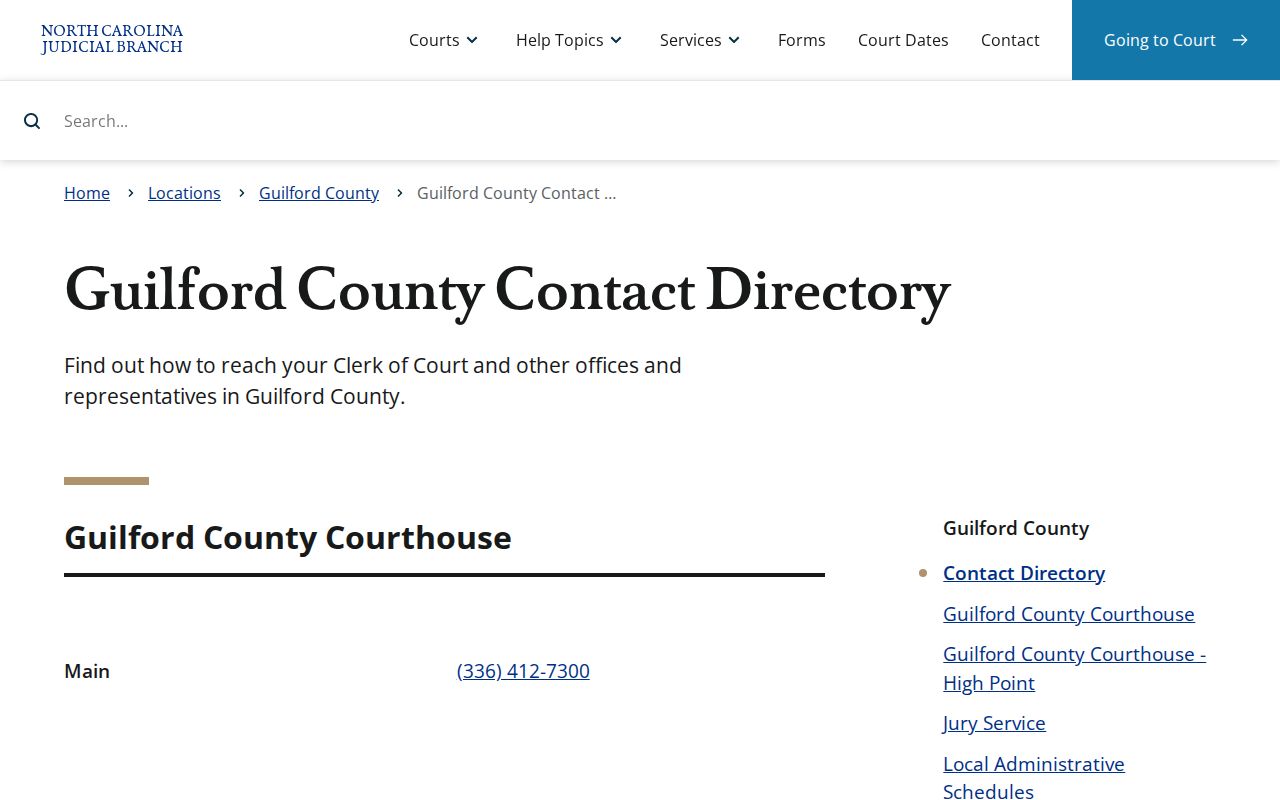
The statewide Portal is not the custodian of the complete case file. Greensboro and High Point clerk offices supply official copies and paper files. Public terminals at county clerks can search statewide criminal cases and also reach civil, estate, and special-proceeding information. Juvenile, adoption, expunged, sealed, and confidential family material does not appear as an ordinary public result.
| Record path | Best use | Fallback |
|---|---|---|
| NC Court Portal | Party and case index | Local clerk |
| District Court | Misdemeanors, lower-value civil, family matters | Clerk counter or terminal |
| Superior Court | Felonies, higher-value civil matters | Clerk counter or terminal |
| Estates and special proceedings | Probate and related files | Clerk’s office |
Two Guilford County Records Hubs
Greensboro may be the county seat, but a Guilford County records search should not assume that every counter is downtown. The Register of Deeds maintains service points in Greensboro and High Point. Court operations also serve both cities. This split reflects the county’s two major urban centers and can save a needless trip when a researcher confirms the file location first.
Geography also affects municipal records. Greensboro, High Point, Jamestown, Gibsonville, and smaller towns keep their own permits, minutes, and administrative files, while deeds, county taxes, courts, and elections stay countywide or statewide. A Greensboro or High Point mailing label does not prove city jurisdiction. Parcel and municipality layers in county GIS help identify the proper local custodian.
Note: For an in-person Guilford County lookup, call ahead with the record type, name, date range, and case, parcel, or book reference.
Guilford County Vital Records Search
The Register of Deeds issues Guilford County birth, death, and marriage certificates. Divorce decrees come from the Clerk of Superior Court, while North Carolina Vital Records handles the statewide certificate function. A recent certificate is not an open name directory. Under G.S. 130A-93, certified copies require identity, relationship, and identification rules that cover the named person and specified family or legal representatives.
Guilford County research holdings begin in November 1913 for births and September 1911 for deaths. The county’s request form supports certified or uncertified birth, death, and marriage requests. A mailed request needs the event facts, requester relationship, signature, photo identification, and payment. Fax and email orders are not accepted. The county states that mail orders are processed within three working days after receipt.
- Certified copy
- An official copy bearing the custodian’s certification, used when legal proof is required.
- Index
- A finding record that points to an event or document but is not the certificate itself.
- Decedent
- The person who died, as named in death, estate, cemetery, and obituary records.
- Book and page
- The recorded citation used to retrieve a deed, marriage entry, or other bound record.
Historical evidence can still be public even when a recent certified copy is restricted. Marriage indexes, cemetery records, newspaper notices, court divorce captions, and archival death materials can establish dates and relationships without bypassing certificate rules.
Guilford County Voter Record Clues
The NCSBE Voter Search provides a public profile with registration details, election districts, polling place, sample ballot links during an active election, certain absentee or early-voting status fields, and voter history. History shows the election, county, precinct, and voting method. It never reveals ballot choices. Search by first and last name, then use year of birth, Guilford County, and status to narrow common names.
Dates of birth, Social Security numbers, driver-license numbers, and protected addresses do not become public through the voter profile. North Carolina also limits uses of computerized voter lists under G.S. 163-82.10. The detailed search fields, public/confidential split, downloadable files, and local correction route are covered in the Guilford County voter registration lookup.
Note: An inactive or removed voter status needs context and does not by itself prove that a person died or moved from Guilford County.
Guilford County Historical People Search
Modern portals thin out as dates move back. Greensboro Public Library’s North Carolina Collection holds city directories, county and family histories, newspapers, maps, census sources, and cemetery material. High Point Public Library’s Heritage Research Center preserves a parallel trail shaped by High Point’s furniture and textile history. Because the two cities developed distinct newspapers and directory runs, one catalog should not substitute for the other.
The High Point Heritage Research Center is one source for local directories, photographs, newspapers, and family collections.

That collection can place a person within High Point’s business, neighborhood, and family record trail when countywide indexes show only a broad match.
The FamilySearch catalog for Guilford County adds a catalog route to deeds, vital material, probate, church, and other family-history sources.
The catalog result is a pointer to record groups, not proof about a person. Note each title, creator, date span, film or digital access note, then compare it with county and State Archives holdings.
Slave Deeds Recover Guilford Names
Guilford County’s Slave Deeds project is an unusual official genealogy tool built from recorded instruments dated 1774 through 1826. Its search accepts text and can limit by date, grantor, grantee, or enslaved person. Results provide date, book, page, parties, the enslaved person’s indexed name, and a download route. Detail pages add document type, amount, party information, and the scanned deed.
The official Guilford County Slave Deeds search pairs the index with original images.
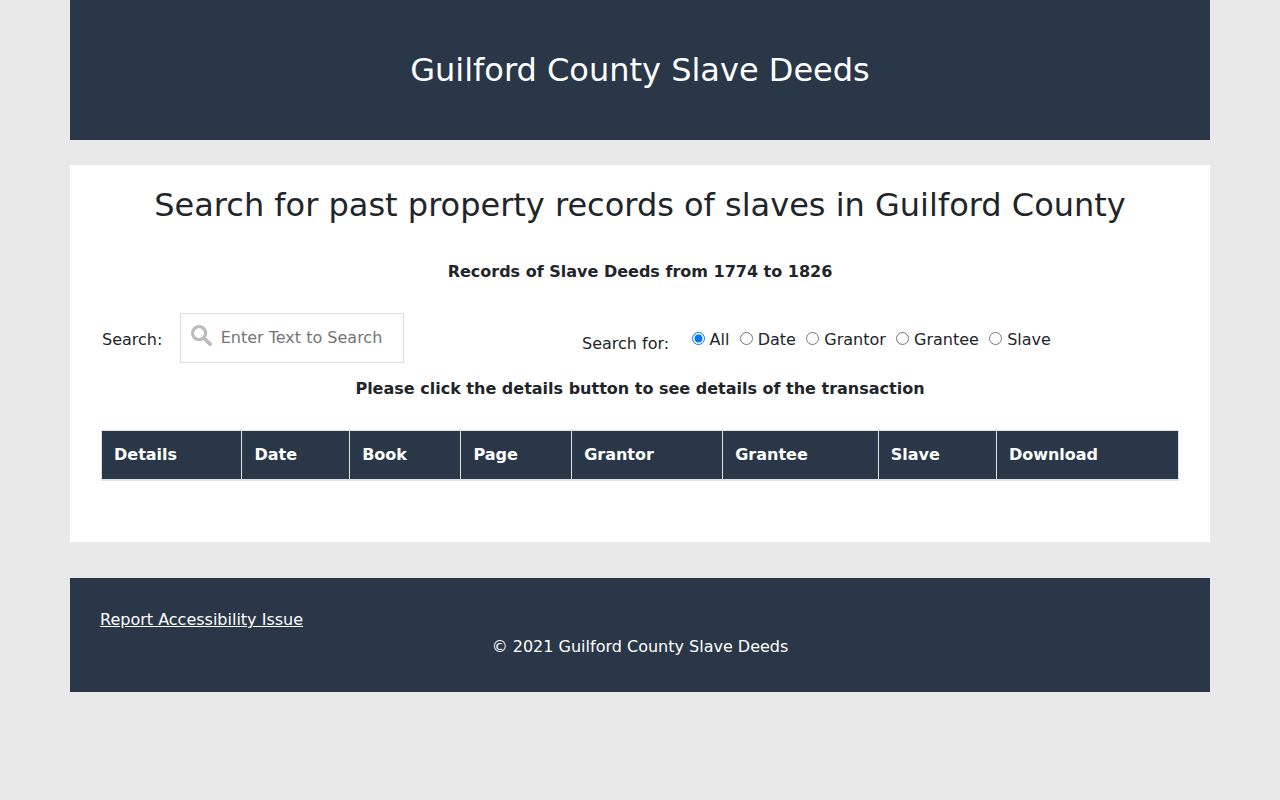
The index can recover people whom conventional records treated as property or recorded by first name only. Historical bias still shapes the entries. Confirm each indexed name in the image, then build context from estate files, tax lists, Quaker and church records, and later records of freed families. Precise language matters because a match documents an appearance in an instrument, not a full life story.
Guilford County Records Survived Loss
Guilford County was formed in 1771 from Rowan and Orange counties, and Randolph County was carved from Guilford in 1779. Those boundary dates decide which county index may hold an early family. British forces burned Guilford records from 1771 through 1781, yet the loss was not total. Deeds survive from 1771, including early deed books, and more than 900 pages survive from 1801 through 1811.
The State Archives county records guide routes researchers to surviving deeds, estates, court minutes, bonds, taxes, and related series.
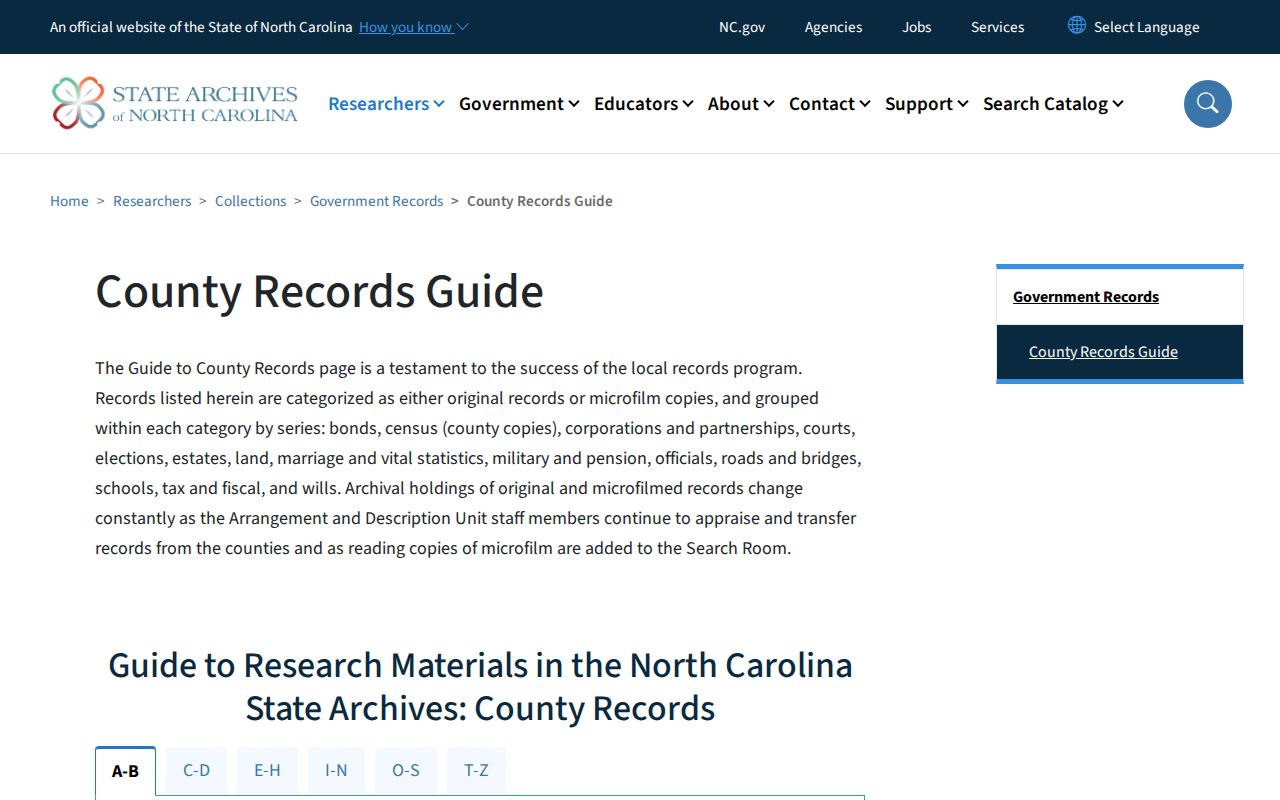
The guide helps separate a true series gap from a record that moved to an archive, microfilm run, or old index book. City directories and tax lists also help bridge the lost 1890 federal census. An effective chain may move from an 1887 directory to a marriage bond or newspaper, then to the 1900 census while testing spelling, occupation, and neighborhood.
Guilford County Business Name Trails
A person connected to a business may appear in several official roles. The North Carolina Secretary of State entity search can show company status, formation date, registered agent, office addresses, and filed documents. Guilford County assumed-name records add local trade-name filings. State occupational boards may verify a licensee’s name, license number, status, dates, and discipline. Permit records can then tie an owner, applicant, or contractor to a project address.
Roles must stay distinct. A registered agent is not always the business owner, and an office address is not always a residence. Confirm the same individual through filing dates, middle names, licenses, deeds, or other records. City or county permit files may identify an applicant, owner, contractor, project address, issue date, work description, and status, but a named role still does not prove current residence.
| Source type | Person link | Key limit |
|---|---|---|
| Secretary of State | Agent, officer, filing party | Address may be an office |
| Assumed name | Local filer and trade name | Check filing date |
| License board | Licensee and status | Boards use separate systems |
| Permit record | Applicant, owner, contractor | Role may be project-specific |
Safe Guilford County Records Use
Public access does not permit threats, harassment, impersonation, or fraud. Compare records only for lawful personal research, civic transparency, family history, estate work, scam checks, or similar legitimate needs. The North Carolina Address Confidentiality Program gives qualified survivors a substitute address and mail forwarding. Do not republish a protected address found in an old source.
G.S. 132-1.10 also provides a written, no-fee route to request removal of specified Social Security, taxpayer ID, driver or state ID, passport, account, payment-card, and security-code information from certain public web images. The requester must identify the data, document, and exact location. A public index can remain open while protected data within an image is redacted.
Commercial compilation services may merge people with similar names or show stale addresses. Official records are usually better for a date, role, and source trail, but even an official index can contain errors or lag behind a recent event. Save the record date and confirm important facts in the underlying file.
When Guilford County Portals Stop
Not every useful record is online. Older deeds may require Book-Page or Old Index Books. Full court files come from the local clerk. Archival directories, newspapers, and family collections may be on microfilm or available only in a reading room. Recent vital certificates require an application and eligibility. A precise request works better than asking an office to research a person or create a new report.
Under North Carolina Public Records Law, Chapter 132, any person may inspect public records at reasonable times and request copies. The law calls for copies as promptly as possible but sets no fixed number of days. State the record type, names, address, case or parcel number, and date range. Ask for an existing index or file, choose inspection or a copy format, and request the statutory basis plus any separable public portion if material is withheld.
For a missing Guilford County trail, work backward through custodians. Start with the web index, contact the Greensboro or High Point counter, check the two local library systems, and then use the State Archives guide. This chain distinguishes an access limit from a search error, an undigitized volume, or a record held by another office.
Note: North Carolina’s actual-cost rule applies to ordinary uncertified copies, while certified records and specialized products follow their own published fee schedules.