
Which Guilford County Public Records Are Open
North Carolina Chapter 132 starts with broad access. Public records made or received in government business can include paper, email, maps, databases, and other formats. Any person may inspect an open record at a reasonable time under reasonable supervision. Yet access is record-specific. A free online index may show that a deed or case exists, while the image, certified copy, or complete file comes from the office that keeps it.
| Guilford record | Official keeper | Online route | Practical access |
|---|---|---|---|
| Deeds, liens, and plats | Register of Deeds | BIS name and book/page search | Free index and inspection; paid copies |
| Property ownership | Tax and Land Records | Real Property Listing and GIS | Free current roll and map tools |
| Court and estate files | Clerk of Superior Court | NC Court Portal | Index online; files and copies from clerk |
| Birth, death, and marriage | Register of Deeds or NC Vital Records | Applications and selected indexes | Certified copies require eligibility and ID |
| Voter registration | NCSBE and county elections office | Voter Search and weekly files | Public fields only; protected data excluded |
| Jail and correction records | Sheriff or NC Adult Correction | Separate county and state searches | Scope depends on the custody system |
The label matters. A jail charge is an allegation, not a conviction. A property mailing address is not proof of residence. Voter history shows participation, never a ballot choice. Sealed cases, juvenile and adoption files, much investigative material, protected addresses, and sensitive personal numbers do not become open merely because another field in the same system is searchable.
Inside Guilford County Deed Records
The Guilford County Register of Deeds offers a detailed name index for recorded land instruments. Search by a person or company, narrow the party to grantor or grantee, select an instrument group, or retrieve a known book and page. A grantor transfers an interest; a grantee receives it. Online coverage is stated by book range, not one start year: real estate begins at Book 3192, plats at Book 70, and condominiums at Book 3. Earlier material remains reachable through old index books and book-page tools.
| Index field | Control | How to use it |
|---|---|---|
| Instrument category | Checkboxes | Limit results to deeds, liens, maps, powers of attorney, releases, UCCs, or other groups |
| Party and entity type | Radio buttons | Choose grantor, grantee, person, company, or both |
| Last or company name | Text | Primary name field, with optional first name |
| Date range | Date pair | Uses month, day, and year; dates before 1997 are reduced to the year |
| Book, page, suffix | Text | Opens a known reference through the alternate book search |
Results identify indexed parties and roles, instrument type, recording date, and book-page or instrument reference. The image may add a legal description, parcel reference, signatures, and return address. It proves a recorded transaction, not who occupies the land. Broad surnames need care: one Smith test produced 15,854 name entries, and selections above 2,000 trigger a warning to narrow the range.
Reading Guilford County Property Records
The county appraisal system accepts parcel number, owner, or address. Owner names work best as “Last name, First name” with at least three letters. Parcel numbers use up to seven digits without leading zeros. Address searches can start with three street letters or three digits, but a number such as 515 may also match 5515 and 5153. Record the parcel number before opening map layers.
The Guilford GIS online services hub brings the parcel viewer, tax, foreclosure, planning, and historical-property tools together.
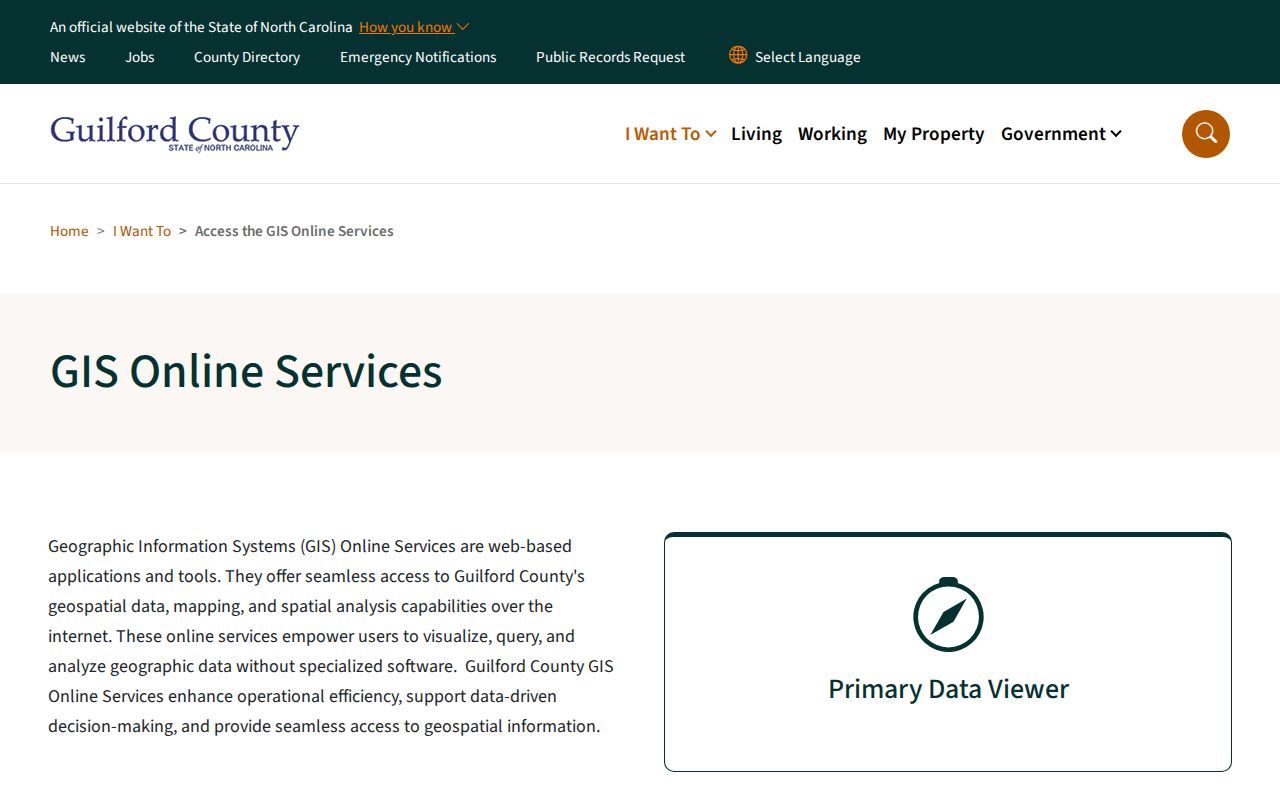
The hub is best used after the appraisal search supplies a parcel identifier. GIS boundaries are reference geometry, not a legal survey.
A mailing address can point somewhere other than the parcel, but it may belong to a trust, office, tax service, or post-office box. It is a lead, not confirmed residence.
Guilford County Court Records Have Layers
The statewide NC Court Portal is a search layer, not the custodian of Guilford’s full case files. It supports names, case numbers, attorneys, location, case type, status, and date filters. Results may show a caption, filing date, parties and roles, events, charges, or dispositions. Some documents can be viewed online. Others, including certified copies and the legally operative file, must come from the Guilford County Clerk of Superior Court.
Public terminals at county clerk offices search statewide criminal matters by defendant, case number, victim, or witness. They also expose civil, estate, and special-proceeding information. Noncertified statewide criminal information can be viewed or emailed without charge, while printed copies may cost. Paper files remain in the filing county. Guilford courthouses received public eCourts kiosks with scanners, printers, and payment services in June 2025.
The Judicial Branch records-request form is for records held by the Administrative Office of the Courts, not local case documents.
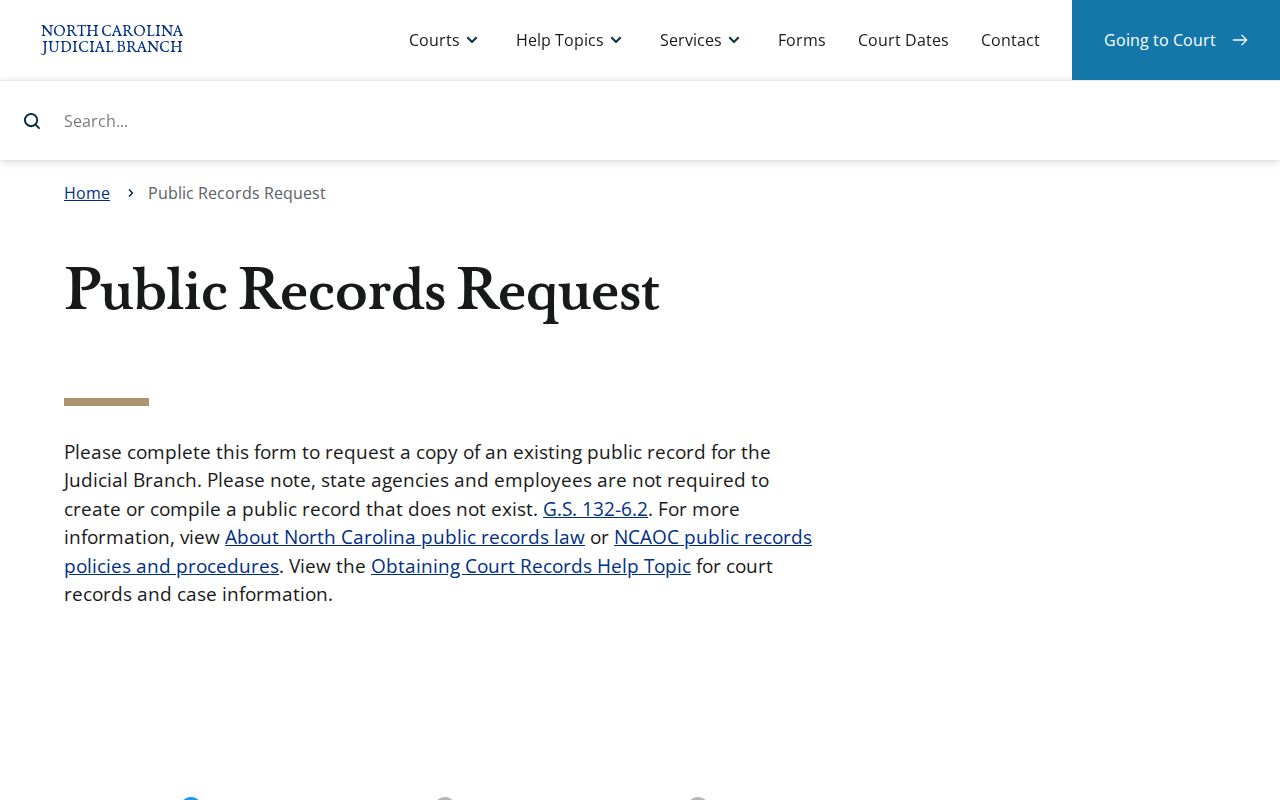
For a Guilford case, contact the clerk with the case number, party name, approximate year, division, and the type of copy required. That distinction prevents a request from reaching the wrong agency.
Vital Records Have Access Gates
Birth, death, and marriage certificates do not follow the same open-index rules as deeds. Guilford’s Register of Deeds issues local certificates, while NC Vital Records handles statewide events. Under G.S. 130A-93, a certified copy generally requires a qualifying relationship or legal role, identification, and an application. The approved group includes the named person, spouse, sibling, direct ancestor or descendant, steprelatives, an authorized representative, or a person seeking a legal determination of personal or property rights.
Mail requests use Guilford’s form, photo ID, payment, and an original signature. Fax and email orders are not accepted. County research holdings begin in November 1913 for births and September 1911 for deaths. Historical indexes, obituaries, cemetery registers, and court divorce captions may provide evidence, but they do not create a right to a recent certified certificate. Divorce decrees stay with the clerk; the state divorce record is not the full court file.
Guilford County Records Custodian Offices
Choosing the custodian comes before choosing the request method. The Register of Deeds holds land instruments and county vital records. Tax and Land Records maintain appraisal and ownership fields. The Clerk of Superior Court keeps Guilford civil, criminal, estate, and special-proceeding files. Each office can explain whether its online result is enough or whether an inspection, paper copy, or certification is needed.
Register of Deeds, Greensboro
201 W. Market St.
Greensboro, NC 27401
336-641-7556
Recorded-name index
Register of Deeds, High Point
325 E. Russell Ave., Room 155
High Point, NC 27260
336-641-7556
Superior Court Clerk, Greensboro
Guilford County courthouse services
336-412-7300
Superior Court Clerk, High Point
High Point courthouse services
336-822-6700
Two Guilford County Records Counters
Greensboro is the county seat, but High Point is not merely a referral point. It has both a Register of Deeds counter and a courthouse. The shared deed-office hours are 8:00 a.m. to 5:00 p.m. on weekdays, with marriage licenses and out-of-county births ending at 4:30 p.m. The High Point clerk has a midday closure between its morning and afternoon service periods.
This two-city setup is useful when an online index fails, an old volume needs inspection, or a certified copy must be ordered. It also makes office selection important. Court paper files remain where the case was filed, and a drop box accepts filings rather than serving as a record-inspection counter. Call the appropriate division before traveling with a complex or older request.
Note: Greensboro or High Point in a mailing address does not by itself establish which city government has jurisdiction over a property.
Guilford County Records Copy Fees
Inspection is not the same product as a certified copy. Chapter 132 allows ordinary uncertified copy charges based on actual reproduction cost. It excludes costs an agency would have incurred anyway. A reasonable special service charge may apply when a request requires unusually extensive technology, clerical, or supervisory help. Ask for an estimate and decide whether electronic delivery, inspection, or a narrower date range will meet the need.
The Guilford Register of Deeds fee schedule lists certified land-record copies at $5 for the first page and $2 for each added page. Uncertified copies are $0.05 at the office or $1 per page by mail, and a certified plat copy is $5.
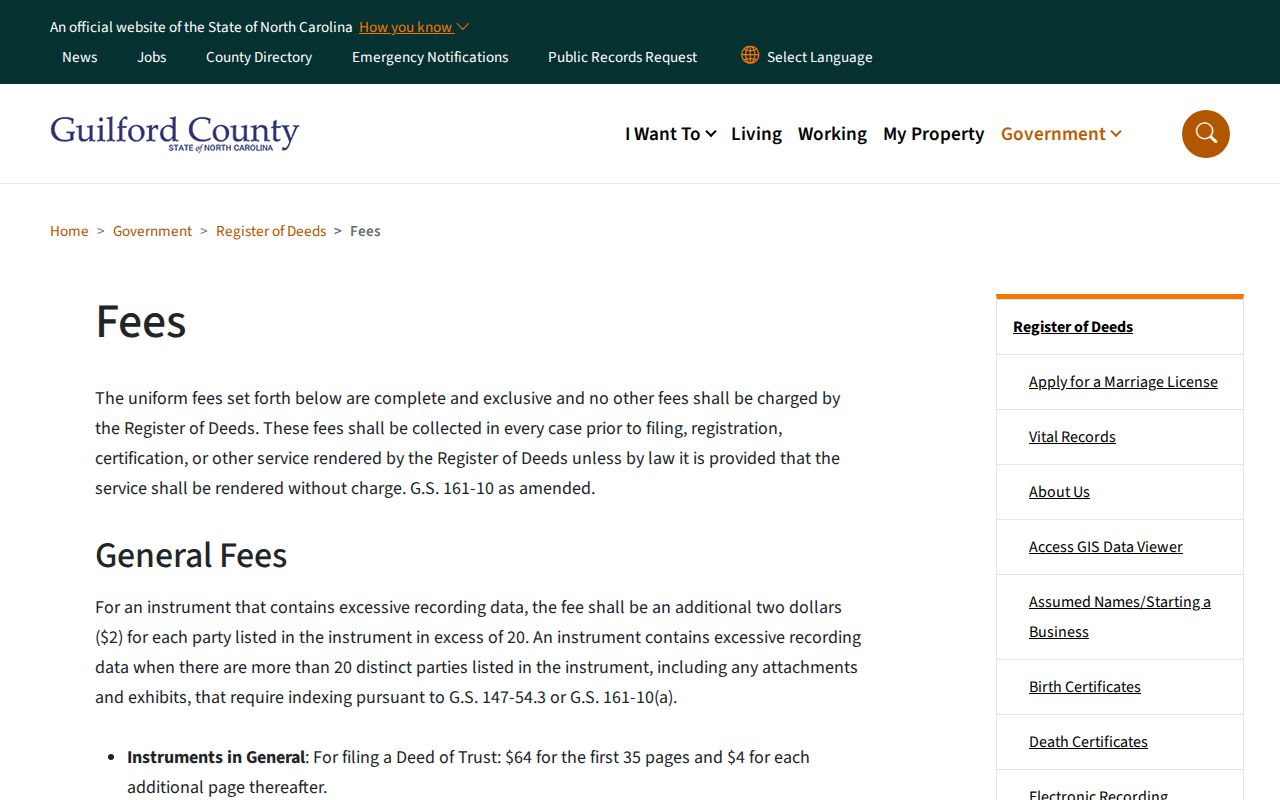
The schedule also separates copy charges from recording charges. Confirm the current amount before ordering because county budgets and service costs can change.
Records Guilford Must Keep Closed
Open government law has firm boundaries. Juvenile and adoption files, sealed or expunged cases, protected voter and Address Confidentiality Program data, personnel files, tax information, and Social Security or financial identifiers have statutory protection. Criminal investigative material is generally outside the Chapter 132 definition, though specified arrest and event facts remain open. DMV personal data is limited by federal and state law.
- Index
- A finding tool that points to an entry or file. It may not include the underlying image.
- Certified copy
- An official reproduction authenticated by the custodian for uses that require proof of the record.
- Custodian
- The agency or official responsible for keeping and providing the record.
- Exemption
- A law that closes all or part of a record despite the general access rule.
A custodian should separate and release nonconfidential parts when that can be done. If access is refused, ask for the statute behind the decision. G.S. 132-9 supplies a civil enforcement route, with mediation procedures potentially applying before litigation.
Protecting Data in Guilford County Records
Historic scanned instruments can expose numbers that modern filings routinely redact. G.S. 132-1.10 allows a written, no-fee request to remove specified Social Security, taxpayer ID, driver or state ID, passport, bank, card, PIN, or password data from a register or clerk public website. The requester must identify the exact information, document, and location. Guilford reported completing an online-image effort in 2008 that redacted more than 40,000 Social Security numbers.
The Register also links a free Property Fraud Alert. It sends notice when a new recording matches an enrolled name. It does not block a filing, prove fraud, replace title insurance, or decide ownership. Treat an alert as a prompt to inspect the instrument and contact the Register. Private deed-copy solicitations can charge far more than the county, so verify copy offers through 336-641-7556.
Guilford 2026 Property Records
Guilford’s 2026 reappraisal means appraisal results can show changing assessed values. County tax pages state that residential notices went out in February, commercial notices in March, and the appeal deadline was May 15, 2026. A value displayed during the cycle should be read with its valuation date and appeal status rather than treated as a timeless figure.
The county’s Mapping and Ownership Transfer office explains how the main identity fields serve distinct roles. Situs describes the parcel location. Mailing address is where the tax notice goes. Deed book and page point back to the recorded transfer. GIS displays location and selected layers.
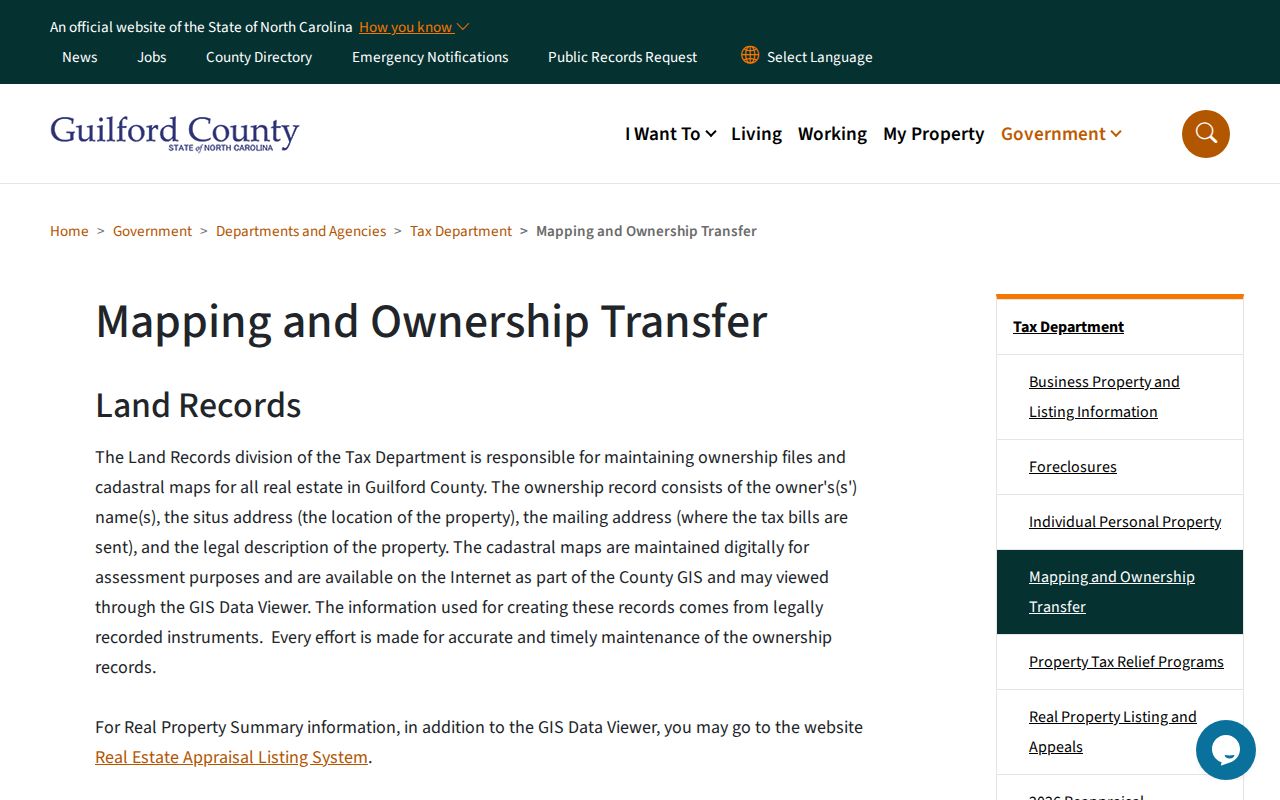
The county explanation helps show why an owner name may stay stable while value or mailing data changes. For a legal boundary, use the deed, recorded plat, and a survey rather than a web map.
Request Guilford Public Records
Chapter 132 lets any person request existing public records. It requires copies “as promptly as possible,” not within an invented three-, five-, or ten-day window. The clearest request names the record type, person, address, case, parcel, or document number; gives a useful date range; and states whether inspection, an electronic file, paper, or certification is needed. A question asking an office to create an analysis is not the same as asking for a record it already keeps.
- Identify the actual custodian. Use the Register for deeds, Tax and Land Records for property fields, and the clerk for local court files.
- Check the official index first. Save the book-page, parcel, case, or instrument number that will help staff locate the file.
- Submit through the office’s published portal, email, mail, or counter route. Keep the confirmation and ask for rolling production if the request is large.
- Choose the least costly useful format. Request a price estimate before approving certified copies or extensive service work.
- If material is withheld, ask for the statutory basis and any segregable remainder. Narrow an overbroad date range when that solves the problem.
The official text of G.S. 132-6 sets the inspection and prompt-copy duties.
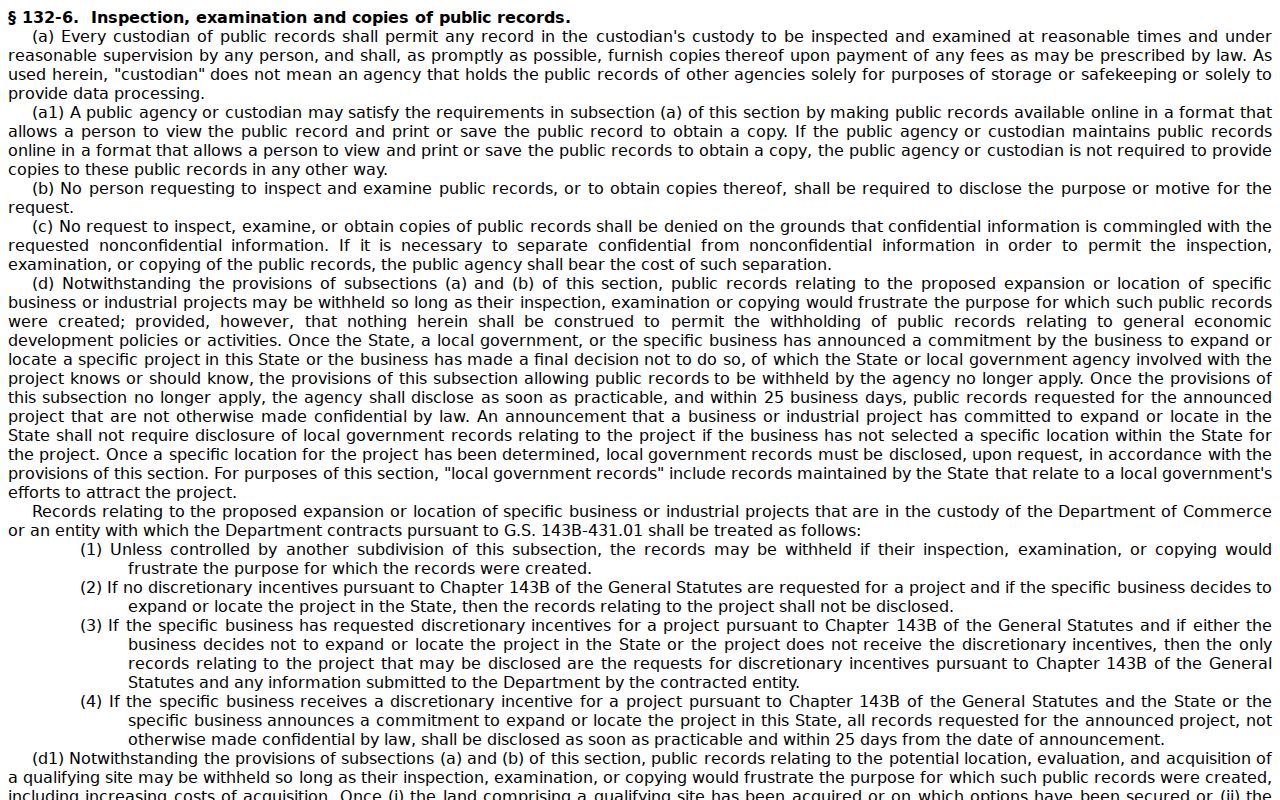
The statute is the best reference when a request channel or response time is unclear. It also confirms that online access may satisfy inspection duties when the requested material is available there.
Use records lawfully. Open access does not permit stalking, threats, intimidation, impersonation, or fraud. Confirm sensitive facts with the custodian before acting on them.