
Map Guilford County People Directories
No list covers everyone in Guilford County. Government directories identify public roles. Education directories focus on faculty and staff. Deed and tax indexes list recorded roles, while professional boards show license status. Historical directories can reach residents who never owned land or held a public post. Start with the list whose purpose matches the person or era.
| Guilford directory | People represented | Keeper | Access path |
|---|---|---|---|
| County employee search | Guilford County staff | Guilford County | Free name search |
| High Point staff list | City employees and officials | City of High Point | Category and name search |
| GCS and university lists | Public faculty and staff | Schools and institutions | Web directories and unit pages |
| Property and deed indexes | Owners, grantors, and grantees | Tax and Register of Deeds | Online search and office |
| License verification | Board-regulated professionals | North Carolina boards | Board-specific searches |
| City and reverse volumes | Past residents and businesses | Greensboro and High Point collections | Digital, microfilm, print, or staff request |
A work listing should be read as a work contact. A deed names parties to a transfer, not all occupants. A tax roll lists the owner and a mailing address, which may belong to a trust, office, or tax service. Those role limits keep Guilford County people directories useful without turning a name match into an unsupported identity claim.
Browse Guilford County Government Directories
The Guilford County employee directory accepts an optional first or middle name and an optional last name, then provides Search and Reset controls. When that broad lookup is thin, department rosters can be richer. The Inspections roster, for example, groups administration, inspectors, plan review, and permitting while showing names, titles, phones, emails, and sometimes office or mobile contact.
| Directory control | Type | Required | Best use |
|---|---|---|---|
| First/Middle Name | Text | No | Search a given name or initial |
| Last Name | Text | No | Search a county employee surname |
| Search | Button | No | Submit the entered terms |
| Reset | Button | No | Clear both name fields |
The official county employee search shows this compact form.
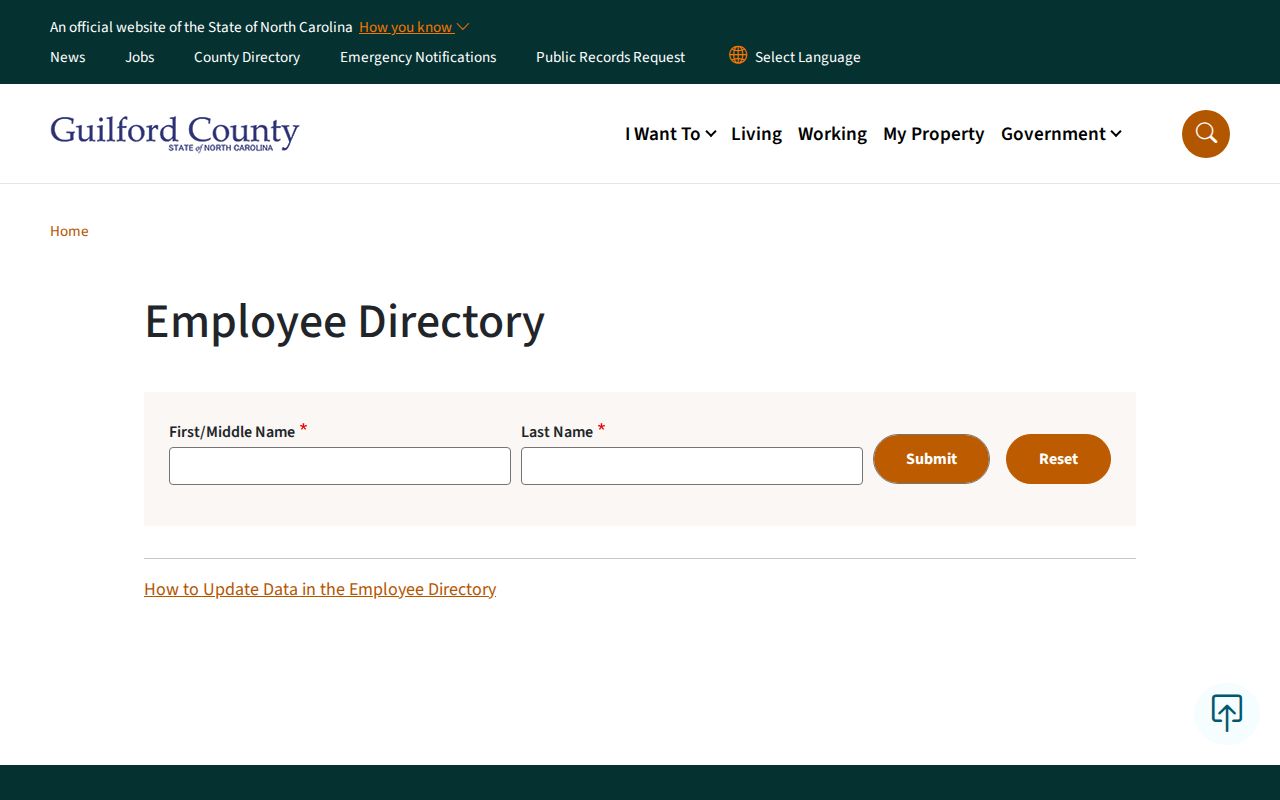
Its simple name fields make department pages and board rosters important fallbacks when a surname produces no useful result.
Greensboro supplies staff contacts through departmental rosters and a telephone PDF, but no verified consolidated city search was found. The High Point staff directory adds a category dropdown to first and last name. Categories span council, clerk, manager, communications, development, engineering, public safety divisions, inspections, library, and parks. State workers can be searched by name and agency through North Carolina’s employee phone directory.
The High Point directory form shows how categories narrow the city’s staff listings.
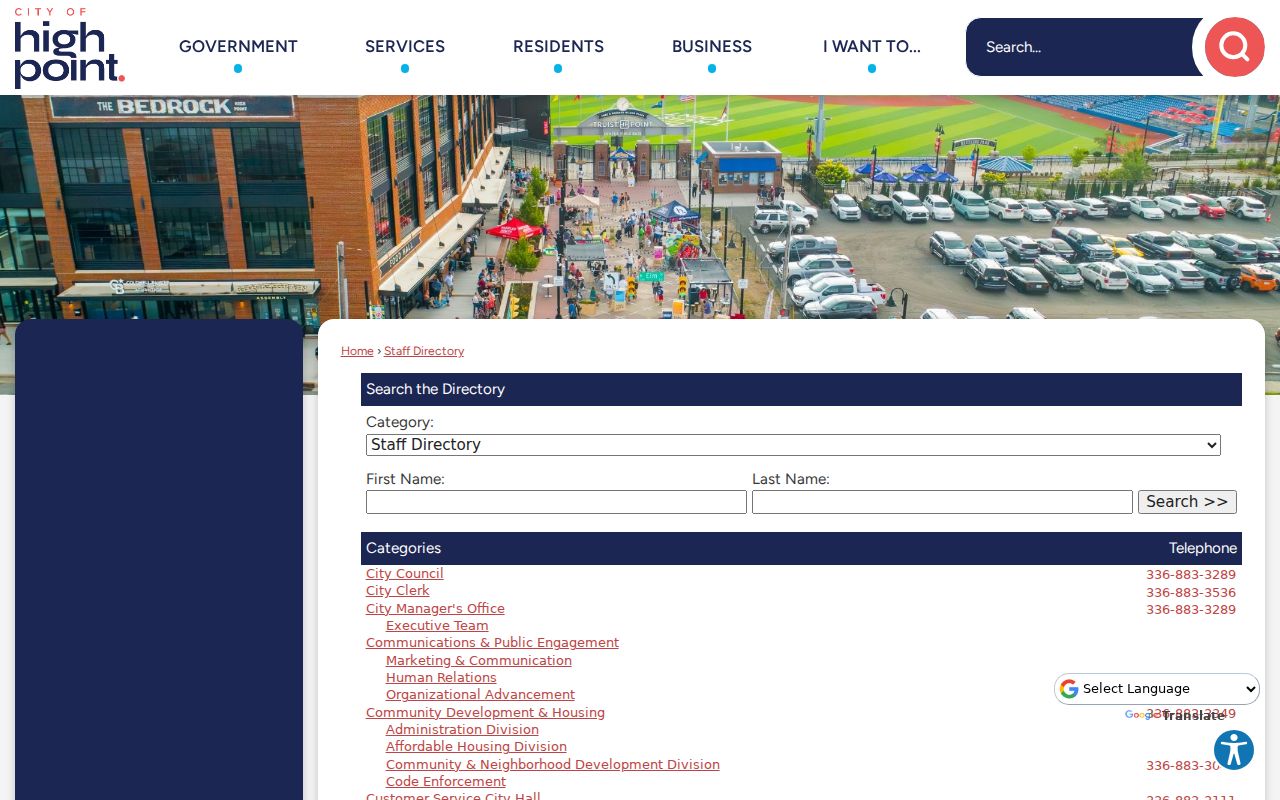
A category search can find the right division even when the employee’s full name or spelling is uncertain.
Search Guilford County Education Directories
Education is one of Guilford County’s strongest public directory networks. Guilford County Schools pages expose first name, last name, location, and search controls, although completeness varies by school. UNCG and NC A&T publish faculty and staff contacts. GTCC spans several campuses, while Guilford College and High Point University maintain public-facing institutional pages.
The UNCG directory accepts a person or organizational keyword and can narrow by department where that filter appears. A result may contain display name, title, unit, campus office, work telephone, university email, and a profile link. Public faculty and staff records are the appropriate focus. Current student lists are restricted by FERPA and should not be assumed open.
- Institutional directory
- A current list made to route people to an office, faculty member, or staff function.
- Yearbook
- A dated published record that may preserve names, activities, class groups, and image-based identity evidence.
- Alumni material
- A published or archival source, not a license to bypass a private, authenticated member directory.
Read Guilford County Directory Entries
Directory fields describe an organizational relationship. High Point detail results may include a name, title, email, phone, extra phone, department address, and hours. A university entry may add an academic unit, campus building, or profile page. County records can show an office and mobile number for staff whose field duties require both.
| Display name | The professional or preferred name used by the office |
|---|---|
| Title and unit | The person’s public function and department |
| Telephone | A direct work line, department line, or listed mobile number |
| An official work address when published | |
| Office | A government or campus location, not a home address |
| Profile link | Additional official biography, duties, or professional detail |
Search by function when a surname fails. Department pages, meeting agendas, board minutes, and elected rosters can identify the official responsible for a service. They may also provide a district or term. Keep the listed role attached to the citation so a past entry is not presented as a current post.
Guilford County Property and Deed Directories
Some public indexes work like name directories even though that is not their main purpose. The Guilford Real Estate Appraisal Listing System searches current parcels by owner, address, or parcel number. Owner searches work best with at least three letters and the format “Last name, First name.” Results can show the owner, tax mailing address, situs address, parcel number, legal description, value, sales, and GIS links.
Situs means the physical property address. It differs from the tax mailing address. A separate mailing address can point to an owner’s contact location, but it may instead be a trust, office, post-office box, or tax service. A parcel card does not establish who lives at the site.
The Register of Deeds name index lists grantors and grantees, which are the parties transferring and receiving an interest. It also identifies instrument type, recording date, and book/page or another document key. A deed proves a recorded transfer, not current occupancy. For access-law and copy questions, use the Guilford County public records search treatment rather than reading the index as a residential roster.
Role check. An owner, grantor, grantee, registered agent, voter, or licensee appears for a specific reason; none of those labels alone proves residence.
Verify Guilford County Professional Directories
North Carolina professional directories are maintained board by board. Useful sources include the State Bar, Medical Board, Board of Nursing, Real Estate Commission, General Contractors Board, engineering and surveying board, cosmetology and barber boards, and educator-license verification. North Carolina’s occupational licensing board index routes a search to the correct regulator.
- Search a person or company name, then add a license number or location where the board supports it.
- Record license type, current status, issue or expiration dates, and discipline as separate facts.
- Use the board result as proof of the licensed role, not as proof of a home address.
- For a company, compare the license with the Secretary of State entity search.
Secretary of State filings may show legal name, status, addresses, agents, and filed documents. An agent is not necessarily an owner. Guilford assumed names appear in the deed index.
Search Both Guilford Directory Libraries
The Greensboro North Carolina Collection and the High Point Heritage Research Center are complementary. Greensboro is strongest for county-seat sources, Greensboro newspapers, and city volumes. High Point holds the furniture and textile city’s own directories, newspapers, images, and family files. Search both places when a person moved within Guilford County or lived near the two cities’ service areas.
| Collection | Verified directory span | Ways to use it |
|---|---|---|
| Greensboro History Museum digital volumes | Selected 1879/80 through 1981/82 | Online named volumes |
| Greensboro physical main editions | 1984-86, 1988-2004 with gaps, 2006-07 | Library or museum holdings |
| Greensboro suburban editions | 1966, 1969-80, selected 1982-2004 | Physical collection |
| High Point city directories | First volume 1908; printed holdings 1910 to present | In person, some online, or staff lookup |
High Point limits remote directory lookup to five years per request and one specific request per day. Mailed copies cost $2 for the first five pages and $0.25 for each added page, up to 20 pages. Staff may email one scanned item per inquiry and day at no charge as time permits. Greensboro microform 317.56 G81 is described as more complete than the listed physical runs.
Note: A year shown in an inventory proves a held volume, not the first or last year that a publisher issued the directory.
Trace Historic Guilford County Directories
City volumes follow Guilford’s urban growth. Early entries tend to run by surname and may list an occupation, spouse, business, or street. Later telephone books add phone data. Reverse or criss-cross directories invert the list, starting with an address and showing the named occupant. That arrangement is useful for household members absent from deeds.
| 1771 | Guilford County was formed from Rowan and Orange Counties |
|---|---|
| 1779 | Randolph County was carved from Guilford, changing the right courthouse trail |
| 1879/80 | Earliest volume in the verified Greensboro digital inventory |
| 1908 | High Point’s first city directory |
| Later era | Telephone and reverse-address formats broaden address-based research |
The loss of most of the 1890 federal census makes directories, tax lists, marriage bonds, newspapers, and cemetery records more valuable. One sound chain is an 1887 directory entry, a marriage bond or newspaper item, then the 1900 census. Initials, spouse or widow labels, race classifications, and old street names need to be checked against the scanned source rather than modern assumptions.
Guilford Slave Deeds Name Directory
The Register of Deeds’ Slave Deeds project is a rare local name-recovery resource covering 1774 through 1826. Users can search text across date, grantor, grantee, or enslaved-person fields. Results identify date, book, page, parties, enslaved people, and a scanned original. A detail page can also show document type and amount.
This historic directory must be read with care. Enslaved people may appear by first name only or in descriptive text. Pair a result with estate files, tax lists, church material, and later Freedmen’s sources. The image preserves context that an index row cannot.
British forces burned Guilford records from 1771 through 1781, but the loss was not total. Deeds survive from 1771, including early books, and more than 900 pages survive from 1801 through 1811. Search each archival series instead of assuming every early person record disappeared.
Guilford Obituary and Burial Directories
Greensboro Library combines several person indexes: Greensboro-Patriot obituaries from 1826 through 1899, Guilford marriage bonds, and Welborn’s 1935/36 tombstone records. Its municipal burial directory covers Forest Lawn, Green Hill, and Maplewood with more than 35,000 burials and ongoing updates. A separate military database identifies more than 19,000 Guilford people from the Civil War and World War II.
High Point adds its own newspaper trail. Heritage Research Center staff search the High Point Enterprise obituary and death index at 336-883-3637. Its yearbooks cover six named area schools, and factory newsletters can preserve retirements, weddings, and births absent from a civic list.
Obituaries can name relatives, former homes, churches, cemeteries, and funeral homes. Confirm each relationship with a death record, probate file, or another independent source, since a published notice is evidence from one moment and informant.
Respect Private Guilford Directories
Community, church, alumni, neighborhood, and member rosters are not public merely because an organization exists in Guilford County. Public anniversary books, archived minutes, and deposited historical papers are valid sources. A current directory behind authentication stays private. Do not evade access controls or ask another member to disclose protected entries.
No authoritative countywide alumni, union, fraternal, veterans, or neighborhood-association directory was verified. Such groups may have archival deposits at local institutions. Search a finding aid by group and date, then follow the repository’s rules.
Current residential white pages are not a dependable official source. Dated library phone books and city directories have clearer provenance. Confirm each result in the directory that created the role or record.